Best Air Fryers: The Ultimate Buying Guide for 2026
James Okafor
Coffee & Cooking Appliance Specialist
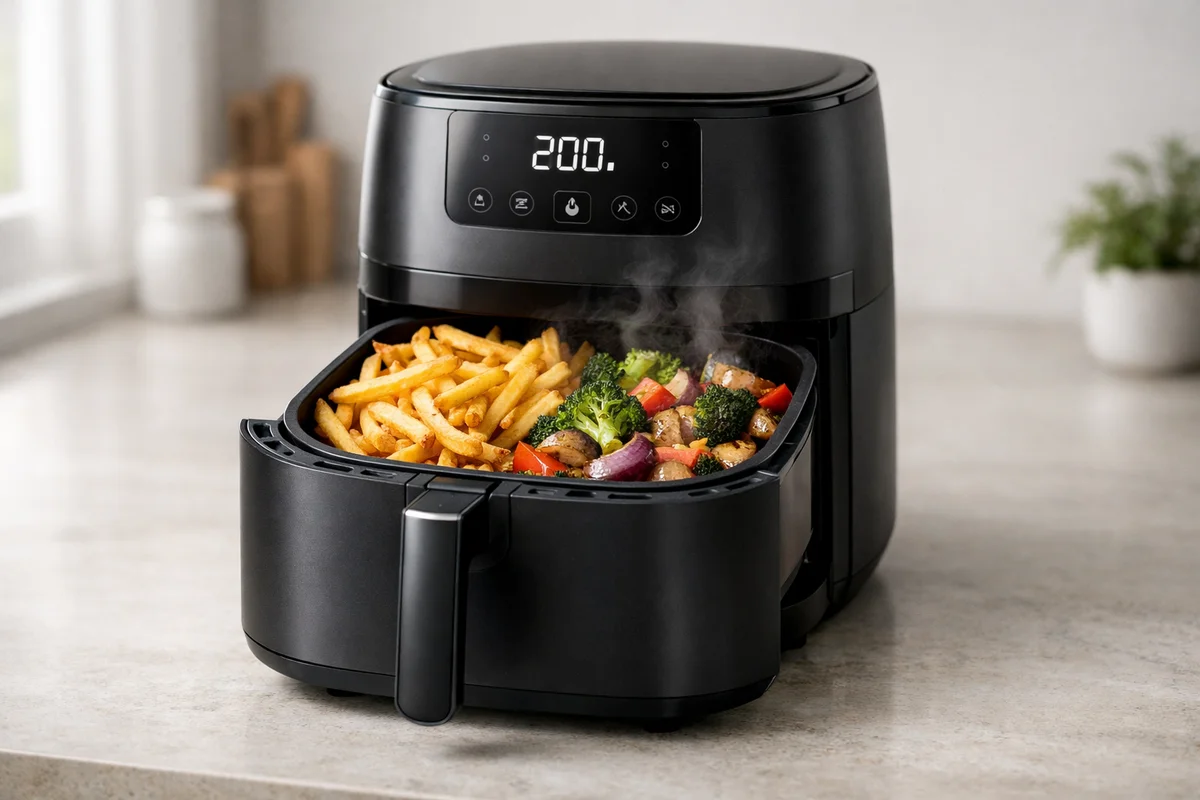
Table of Contents
On this page
26Picking the best air fryers gets confusing fast. Dozens of brands, multiple designs, and spec sheets filled with numbers that seem meaningless until you understand what they do. This guide breaks down every factor that separates a great air fryer from a disappointing one — so you buy the right unit the first time, without overspending.
Whether you cook for yourself or a household of five, the best air fryers match your cooking habits, counter space, and budget. By the end of this guide, you will know exactly which type, size, and feature set fits your kitchen in 2026.
What to Look For in the Best Air Fryers#
Specifications determine performance. Price tags don't. A $150 air fryer with the wrong capacity wastes more money than a $90 unit sized correctly for your household. Here are the specs that actually matter.
Wattage: The Heat Engine#
Wattage controls how quickly and evenly your air fryer reaches cooking temperature. Most air fryers range from 1,200 to 1,800 watts. Higher wattage means faster preheating and crispier results.
For basket-style air fryers, 1,400 watts is the minimum for consistent crisping. Units below 1,200 watts struggle with frozen foods and thick-cut items like bone-in chicken thighs. They take longer to preheat and produce uneven browning.
For air fryer ovens, 1,700 to 1,800 watts is standard because the larger cooking chamber requires more power to maintain even temperatures. An oven-style unit running 1,400 watts will leave cold spots in corners and undercooked food on lower racks.
Pro Tip: Wattage also impacts your electricity bill. A 1,700-watt air fryer oven running 30 minutes daily costs roughly $7–$9 per month. A 1,400-watt basket model running the same duration costs around $5–$7 monthly.
Capacity: Match Your Household Size#
Capacity is measured in quarts. This number is the total internal volume — not how much food you can actually fit in a single layer. Effective cooking capacity is roughly 60% of the advertised number because air fryers need airflow around food to work properly.
Here is how capacity maps to household size:
- 2–3 quarts: One to two people. Handles a single serving of fries, two chicken breasts, or a small batch of vegetables
- 4–5 quarts: Two to three people. The most popular size range. Cooks enough for a standard dinner without batch cooking
- 6–8 quarts: Three to five people. Handles a full pound of wings, a small whole chicken, or a family-sized portion of fries in one round
- 10+ quarts: Five or more people, or meal preppers. Typically oven-style units with multiple racks. Cooks entire meals simultaneously
The most common mistake buyers make is undersizing. A 3.5-quart air fryer forces a family of four to cook in two or three batches. That triples cooking time and eliminates the air fryer's speed advantage. If you cook for three or more people, start at 5 quarts minimum.
Temperature Range: Versatility Factor#
Standard air fryers reach 400°F (204°C). This handles 90% of air frying tasks — fries, chicken, vegetables, reheating leftovers. Some models push to 450°F or even 500°F, which matters for searing steaks or achieving restaurant-style char on Brussels sprouts.
Low-temperature capability is equally important. Air fryers that drop to 180°F (82°C) or lower work as dehydrators for jerky, dried fruit, and herb preservation. Dual-zone models that support different temperatures in each basket open up simultaneous cooking at different heat levels.
Cooking Presets and Controls#
Digital touchscreen controls dominate the market in 2026. Most mid-range models include six to 12 presets for common foods: fries, chicken, steak, fish, shrimp, vegetables, bacon, and baked goods. Presets adjust time and temperature automatically.
Presets are a convenience feature, not a performance feature. Manual temperature and time control matters more. Look for models that allow adjustments in 5-degree increments rather than 25-degree jumps. Precise control produces better results once you learn your preferred settings.
Shake reminders — audible alerts that prompt you to toss food halfway through cooking — are surprisingly useful. They prevent forgotten batches and improve crispiness on items like fries and wings.
Build Quality and Materials#
The cooking basket or tray material affects durability and food release. The three common options:
- Nonstick-coated metal: The standard. Easy cleanup, good food release. Coating degrades over two to four years with regular use. Avoid metal utensils
- Stainless steel: More durable, no coating to wear off. Food sticks more easily without oil. Heavier and more expensive
- Ceramic-coated: PFOA-free alternative to traditional nonstick. Slightly less slippery than standard nonstick but safer at high temperatures. Typical lifespan is two to three years
Check the basket attachment mechanism. Cheap models use a simple button release that loosens over time. Quality units use a secure click-lock system that prevents accidental separation when you shake or flip food.
The exterior housing should be double-walled or insulated. Single-wall plastic housings get dangerously hot during long cooking sessions. Touch the top and sides of an air fryer running at 400°F for 25 minutes — well-insulated models stay warm but not painful.
Types of Air Fryers#
The best air fryers fall into four distinct categories. Each design serves different kitchens and cooking styles. Knowing which type qualifies as the best air fryers for your situation prevents expensive buyer's remorse.
Basket-Style Air Fryers#
The original and most popular design. A pull-out drawer holds a perforated basket where food sits. Hot air circulates around the basket from a heating element above.
Best for: Small to mid-size households, quick weeknight meals, apartment kitchens with limited counter space. Basket models are the fastest at preheating — most reach 400°F in under three minutes.
Capacity range: 2 to 8 quarts. The 4- to 6-quart sweet spot serves most households.
Limitations: Single-layer cooking only. Stacking food blocks airflow and produces soggy results. No rotisserie function. Limited baking capability due to small basket dimensions.
Price range: $40–$150 for quality models.
Air Fryer Ovens (Toaster Oven Style)#
A countertop oven with an air fry function. Multiple racks allow cooking on several levels simultaneously. Most include additional functions: bake, broil, toast, rotisserie, dehydrate, and warm.
Best for: Larger families, home cooks who want a multi-function appliance, anyone replacing both a toaster oven and a standalone air fryer. These units excel at cooking full meals — protein on one rack, vegetables on another.
Capacity range: 10 to 32 quarts. Some models replace a full-size oven for small households.
Limitations: Larger footprint. A 26-quart air fryer oven occupies roughly 16 by 13 inches of counter space and stands 13 inches tall. Preheating takes five to eight minutes — slower than basket models. Air frying performance is slightly less crispy than a dedicated basket unit because the heating element sits farther from the food.
Price range: $80–$300 for quality models.
Dual-Basket Air Fryers#
Two independent baskets with separate temperature and time controls. Cook different foods simultaneously without flavor transfer. The Ninja Foodi DualZone popularized this category.
Best for: Families cooking proteins and sides at the same time. Meal preppers who want efficiency. Anyone tired of batch cooking in a single basket.
Capacity range: 8 to 10 quarts total (typically two 4- to 5-quart baskets). Effective single-basket capacity is comparable to a standard mid-size unit.
Limitations: Wide footprint. Dual-basket models typically measure 15 to 17 inches across. Smart Finish and Match Cook features sound impressive but require learning the timing quirks of each model. The divider between baskets reduces airflow slightly compared to a single-basket design.
Price range: $120–$200 for quality models.
Paddle-Style Air Fryers#
An enclosed pot with a motorized stirring paddle that rotates food automatically during cooking. The Tefal ActiFry is the most recognized name in this category.
Best for: Hands-off cooking. The stirring paddle eliminates the need to shake or flip food manually. Excellent for fries, stir-fry vegetables, and curries. Unique among air fryers because you can add sauces and liquid ingredients without damaging the unit.
Capacity range: 2 to 4 quarts. Generally smaller than other types.
Limitations: Slower cooking times. Paddle models take 25 to 40 minutes for fries compared to 15 to 20 minutes in a basket unit. The paddle can break delicate foods like fish fillets and coated items. Less crispy results overall because the constant stirring prevents sustained contact with hot surfaces.
Price range: $120–$250.
Key Specifications Breakdown#
Understanding spec sheets helps you identify the best air fryers on any shelf. Here is what each number means in real-world cooking terms.
Power-to-Capacity Ratio#
This ratio matters more than raw wattage. Divide wattage by quart capacity to get watts-per-quart. Higher numbers mean faster, crispier cooking.
- Below 200 watts per quart: Underpowered. Expect slow preheating and inconsistent results
- 200–300 watts per quart: Solid performance. The standard for good models
- Above 300 watts per quart: Excellent. Fast, even crisping with minimal preheating
Example: A 1,700-watt, 6-quart air fryer delivers 283 watts per quart — solid performance. A 1,400-watt, 8-quart model delivers only 175 watts per quart — underpowered for its size.
Noise Level#
Air fryers produce 55 to 65 decibels during operation. That's comparable to a normal conversation or a running dishwasher. Basket models with high-speed fans tend to be slightly louder than oven-style units.
Models above 65 decibels become noticeable in open-plan living spaces. If noise sensitivity matters, check user reviews specifically for fan noise complaints. Manufacturers rarely publish decibel ratings.
Footprint and Weight#
Counter space is premium real estate. Measure your available space before shopping.
- Basket models (4–6 qt): 11–14 inches deep, 9–12 inches wide, 11–14 inches tall. Weight: 10–15 lbs
- Air fryer ovens (15–26 qt): 15–20 inches deep, 13–17 inches wide, 10–14 inches tall. Weight: 18–30 lbs
- Dual-basket models (8–10 qt): 14–17 inches wide, 11–14 inches deep, 11–14 inches tall. Weight: 15–20 lbs
Critical measurement: Account for the pull-out clearance behind the unit. Basket air fryers need three to four inches of rear clearance for the exhaust vent. Air fryer ovens need two to three inches. Placing an air fryer flush against a wall or cabinet traps hot air and shortens the unit's lifespan.
Dishwasher Safety#
Most removable baskets, trays, and racks are dishwasher-safe on the top rack. The main unit housing is never dishwasher-safe. Confirm dishwasher compatibility before buying if easy cleanup is a priority.
Nonstick baskets last longer with hand washing. The dishwasher's harsh detergent and high-temperature dry cycle degrade nonstick coatings faster. A quick hand wash with warm soapy water and a soft sponge adds two years to the coating's life compared to daily dishwasher use.
Common Mistakes to Avoid When Choosing the Best Air Fryers#
Years of testing and thousands of reader questions reveal the same mistakes. Even shoppers searching for the best air fryers fall into these traps. Avoid them and you will be satisfied with your purchase.
-
Buying based on brand hype alone. Household name brands charge a premium for marketing, not always for better engineering. Compare specs directly. A lesser-known brand with 1,700 watts, stainless steel internals, and a two-year warranty often outperforms a famous brand's entry-level model at the same price
-
Ignoring the power-to-capacity ratio. A large basket with a weak heating element produces disappointing food. Always divide wattage by quarts. Anything below 200 watts per quart is a red flag
-
Forgetting about counter clearance. Measuring only the unit's footprint without accounting for pull-out space and rear exhaust clearance leads to cramped, overheating installations. Measure total required space — including the basket fully extended — before ordering
-
Choosing presets over manual control. Presets are convenient shortcuts, not cooking solutions. Models with precise manual temperature and time controls always outperform preset-only models once you learn proper air frying technique
-
Skipping the preheat step. Tossing food into a cold air fryer adds three to five minutes of uneven cooking. Preheating for two to three minutes produces noticeably crispier results. Some budget models lack a dedicated preheat function — run the empty unit at cooking temperature for two minutes instead
-
Overcrowding the basket. Air fryers cook by circulating hot air. Overlapping food blocks that airflow and steams ingredients instead of crisping them. Cook in a single layer with space between pieces. Two smaller batches always beat one overcrowded batch
-
Not using oil at all. Air fryers reduce oil, not eliminate it. A light spray of avocado or olive oil on lean proteins and vegetables improves browning, prevents sticking, and adds flavor. Half a teaspoon of oil per serving is enough
Air Fryer Maintenance and Longevity#
Even the best air fryers need regular care. A well-maintained air fryer lasts three to five years with daily use. Premium models with stainless steel components can reach seven years. These habits maximize your unit's lifespan.
Clean after every use. Grease buildup on the heating element creates smoke, off-flavors, and eventually a fire hazard. Wipe the interior with a damp cloth after each session. Deep clean the basket and tray weekly with warm soapy water.
Inspect the nonstick coating monthly. Chipping, flaking, or scratched nonstick coatings release particles into food. Replace the basket when the coating shows visible wear. Many manufacturers sell replacement baskets for $15–$30.
Check the exhaust vent quarterly. Grease and food particles accumulate in the rear vent over time. A blocked vent causes overheating and inconsistent temperatures. Use a soft brush to clear debris.
Pro Tip: Place a silicone liner or parchment round in the basket for messy foods like marinated wings or breaded items. This protects the nonstick surface, simplifies cleanup, and extends the coating's life by months. Ensure the liner has perforations to maintain airflow.
Our Top Recommendations#
Now that you understand the specs and types, finding the best air fryers for your kitchen is straightforward. For specific model recommendations with detailed reviews and test data, explore our best air fryer roundup. We tested over 15 models across all four types and ranked them by performance, value, and durability.
If you are choosing between two specific models, our air fryer comparison guides break down head-to-head differences with side-by-side spec tables and real cooking results.
For general kitchen appliance guidance, browse our blender buying guides and coffee machines reviews — the same testing methodology applies across every category.
Four air fryer types side by side: basket, oven, dual-basket, and paddle models
Best Air Fryers: Price Tiers Explained#
The best air fryers exist at every price point. Understanding price tiers prevents overpaying for features you don't need — and underpaying for build quality you'll regret.
Budget Tier: $40–$80#
Entry-level basket models with 3- to 5-quart capacity and 1,200 to 1,400 watts. Expect basic digital controls, four to six presets, and nonstick baskets. Adequate for singles and couples who air fry three to four times per week.
What you sacrifice: Precise temperature control, build quality, and longevity. Budget models typically last 18 months to two years with daily use. Nonstick coatings degrade faster. Fan motors run louder and hotter.
Mid-Range Tier: $80–$150#
The sweet spot for most households. Quality basket models with 5- to 8-quart capacity, 1,400 to 1,700 watts, and better build materials. Dual-basket models enter this range at the higher end. Expect eight to 12 presets, precise manual controls, and shake reminders.
What you gain over budget: Sturdier construction, quieter operation, more even cooking, and a two-year average lifespan with daily use. Most mid-range units carry a one- to two-year manufacturer warranty.
Premium Tier: $150–$300#
Air fryer ovens with multiple cooking functions, dual-basket units with smart features, and commercial-grade basket models. Capacity ranges from 8 to 30+ quarts. Features include Wi-Fi connectivity, app control, internal temperature probes, and rotisserie attachments.
Worth it if: You replace a toaster oven and air fryer with one unit, cook for four or more people regularly, or meal prep in large batches. The per-use cost drops significantly over a three- to five-year ownership period.
Who Should Buy Which Type#
The best air fryers match specific lifestyles. Here is how to match your situation to the right air fryer type — saving money and disappointment:
- College students and singles: A 3- to 4-quart basket model in the $40–$60 range. Compact, fast, and handles one to two servings perfectly
- Couples who cook together: A 5-quart basket model or entry-level dual-basket unit. The $80–$120 range offers the best value
- Families of three to five: A 6- to 8-quart basket model or dual-basket unit. Budget $100–$180 for a model that eliminates batch cooking
- Meal preppers and entertainers: An air fryer oven in the 20- to 30-quart range. The multi-rack design handles large quantities and multiple functions. Budget $150–$250
- Countertop-limited kitchens: A compact 4-quart basket model. Measure your available space first. Some models fit in as little as 10 by 10 inches of counter space
Frequently Asked Questions#
Frequently Asked Questions
8 questions answered
The best air fryers for beginners are mid-range basket models in the 4- to 6-quart range with digital presets. Presets remove the guesswork from temperature and time settings. Look for a model with a shake reminder feature and at least eight cooking presets. Budget $60–$100 for a beginner-friendly unit.
A basket air fryer is better for speed and crispiness. An air fryer oven is better for versatility and larger batches. Basket models preheat in under three minutes and produce crispier results because the heating element sits closer to food. Oven models handle multiple racks, rotisserie, baking, and dehydrating.
A family of four needs a 6- to 8-quart air fryer to cook full portions in a single batch. A 5-quart model works but requires occasional batch cooking for larger items like wings or chicken thighs. Dual-basket models in the 8- to 10-quart range are ideal for cooking proteins and sides simultaneously.
A good air fryer should have at least 1,400 watts for basket models and 1,700 watts for oven models. The best air fryers deliver 200 to 300 watts per quart of capacity. Divide the wattage by the quart size to check this ratio before buying.
Air fryers use less electricity than conventional ovens. A 1,500-watt air fryer running 30 minutes daily costs approximately $5–$8 per month depending on your electricity rate. A full-size oven uses 2,500 to 5,000 watts, making air fryers 40% to 70% more energy efficient for small to medium meals.
Budget air fryers last 18 months to two years with daily use. Mid-range models last two to four years. Premium air fryer ovens with stainless steel components last five to seven years. Nonstick basket condition and fan motor quality are the two factors that determine lifespan.
Expensive air fryers are worth it if you cook daily for three or more people. Premium models deliver better build quality, quieter operation, more even cooking, and longer lifespans. A $150 model lasting four years costs less per use than a $50 model replaced every 18 months. For occasional use, budget models perform adequately.
Avoid wet batters (like beer batter), very light foods that blow around (leafy greens without weight), large roasts that block airflow, and cheese-topped dishes that drip through the basket. Raw grains and pasta do not work in air fryers. Anything requiring liquid or steam — such as rice, soup, or steamed dumplings — needs a different appliance.
Summary: Choosing the Best Air Fryers in 2026#
The best air fryers match three things: your household size, your cooking habits, and your counter space. Every other feature — presets, Wi-Fi, touchscreens — is secondary to those fundamentals.
Start with capacity. Use the 60% rule: multiply the advertised quart size by 0.6 to get realistic single-layer cooking volume. Then check the power-to-capacity ratio. Anything above 200 watts per quart delivers solid performance.
Choose your type based on lifestyle. Basket models win on speed and crispiness. Oven models win on versatility and batch size. Dual-basket models win on simultaneous cooking. Paddle models win on convenience for stir-fry style dishes.
Avoid the common mistakes — undersizing, overcrowding, skipping preheats, and buying based on brand recognition instead of specifications. A well-chosen best air fryer at $80 outperforms a poorly matched $200 model every time.
For specific product recommendations with full test data and ratings, visit our air fryer reviews and roundups. We test every model we recommend using standardized cooking tests across fries, chicken wings, vegetables, and frozen foods.