Best Air Fryers Under 100$: Complete Buyer Guide 2026
James Okafor
Coffee & Cooking Appliance Specialist
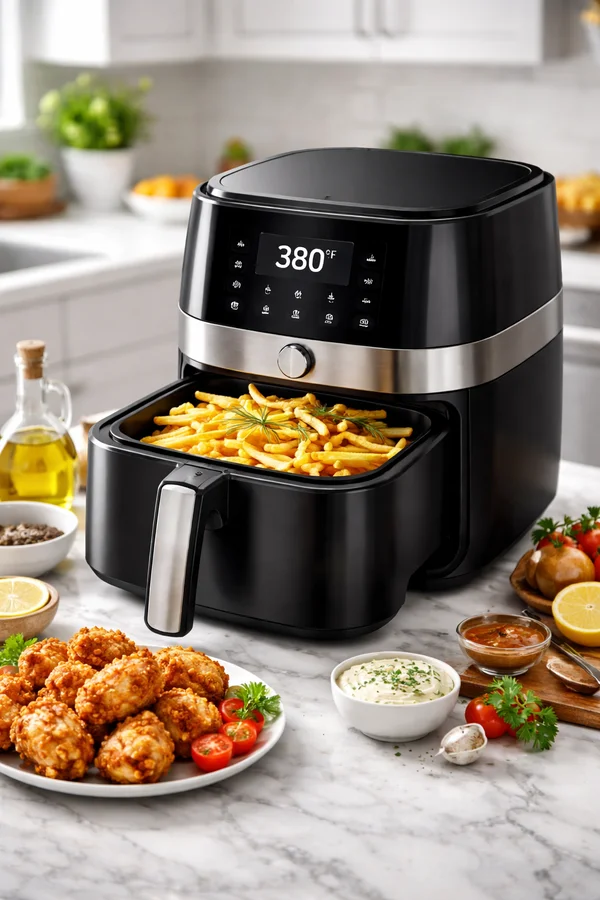
Table of Contents
On this page
20The best air fryers under 100 dollars deliver 80–90% of the performance you get from premium models at a fraction of the cost. The problem is separating the genuinely good budget units from the ones that overheat, undercook, and break within six months. At this price range, every spec decision matters — the gap between a $60 unit and a $95 unit is enormous.
This guide explains exactly what to look for, what to avoid, and how to read spec sheets so you spend once and stay satisfied. Whether you are buying your first air fryer or replacing a worn-out unit without breaking the bank, the best air fryers under 100 are more capable in 2026 than they have ever been.
What to Look For in the Best Air Fryers Under 100#
Budget air fryers pack impressive technology into small packages. However, manufacturers cut costs in specific areas to hit lower price points. Understanding where those cuts happen — and which ones actually affect your cooking — separates a smart purchase from a frustrating one.
Wattage: The Performance Floor#
Wattage determines how quickly your air fryer heats up and how evenly it cooks. Budget models range from 1,000 to 1,500 watts. This single spec has the biggest impact on food quality at the under-$100 price point.
The minimum for crispy results is 1,200 watts. Anything below struggles with frozen foods, thick-cut chicken, and dense vegetables. A 1,000-watt unit takes 20–25% longer to reach target temperature than a 1,400-watt model, and the extended cook times dry out proteins.
The sweet spot for budget air fryers is 1,400 to 1,500 watts. This range preheats in under three minutes, delivers consistent browning on fries and wings, and handles frozen-to-crispy transitions without temperature drops. Several models in the $60–$90 range now deliver 1,500 watts — matching units that cost twice as much just two years ago.
Pro Tip: Calculate the power-to-capacity ratio before buying. Divide wattage by quart capacity. Look for at least 250 watts per quart. A 1,400-watt, 5-quart model delivers 280 watts per quart — solid. A 1,200-watt, 6-quart model delivers only 200 watts per quart — underpowered for its size.
Capacity: Size It Right or Pay Twice#
Capacity is listed in quarts, but the usable cooking space is roughly 60% of the advertised number. Air fryers need airflow around food to work properly. Stacking or overcrowding blocks the convection cycle and produces soggy, steamed results instead of crispy ones.
Here is how capacity translates to real meals:
- 2–3 quarts: One person. Handles a single portion of fries, one chicken breast, or a small batch of vegetables. Ideal for dorm rooms and studio apartments
- 4–5 quarts: Two to three people. The most popular and practical range under $100. Cooks a standard dinner serving without batch cooking — roughly one pound of wings or two servings of fries
- 6–8 quarts: Three to five people. Available under $100 in basket-style models from brands like Cosori and Ninja. Large enough for a small whole chicken or family-sized batches
The most common regret in budget air fryer purchases is undersizing. A 3-quart unit forces a couple to cook dinner in two batches. That doubles the cooking time and eliminates the air fryer's speed advantage entirely. If you cook for two or more people, start at 4 quarts minimum. The price difference between a 3-quart and a 5-quart model is typically just $10–$15.
Temperature Range and Control Precision#
Standard budget air fryers reach 400°F (204°C). This covers fries, chicken, vegetables, fish, reheating leftovers, and most everyday cooking. Some models in the $70–$95 range push to 450°F, which adds the ability to sear steaks and achieve restaurant-style char.
Control precision separates good budget models from mediocre ones. Look for temperature adjustments in 5-degree increments. Cheap units offer only 25-degree jumps — forcing you to choose between 350°F and 375°F when your recipe calls for 360°F. That 15-degree difference affects browning consistency on delicate items like breaded fish and thin-cut vegetables.
Timer controls matter equally. Models with one-minute increments offer practical precision. Models with five-minute jumps make it impossible to fine-tune cook times for items that need exactly 12 or 18 minutes.
Build Quality: Where Budget Cuts Show#
Under $100, manufacturers reduce costs in predictable areas. Some cuts are harmless. Others directly shorten lifespan.
Cuts that don't matter much:
- Plastic exterior instead of stainless steel: Cosmetic difference only. Both insulate equally well. Plastic models weigh less and resist fingerprints
- Fewer presets: Manual temperature and time control matters more than preset buttons. Six presets work as well as 12 for experienced users
- No Wi-Fi or app connectivity: These features add $30–$50 to the price and most owners stop using them within a month
Cuts that significantly affect performance and lifespan:
- Thin nonstick coating: Budget baskets use thinner coatings that degrade faster. Expect 18–24 months of daily use before visible wear. Premium models last three to four years. Proper cleaning extends this dramatically — see our air fryer cleaning guide for the method that doubles coating life
- Single-wall housing: Cheap models skip the inner insulation layer. The exterior gets uncomfortably hot during long cook sessions at 400°F. Not dangerous, but unpleasant — and it radiates more heat into your kitchen
- Weaker basket release mechanism: Budget basket latches loosen faster than premium click-lock systems. Test the mechanism in-store if possible, or check user reviews specifically for "basket falling" complaints
Noise Level: The Hidden Spec#
Air fryers run fans at high speed to circulate hot air. Budget models typically measure 58–65 decibels — about the volume of a normal conversation. This is noticeable but not disruptive in most kitchens.
Cheaper fan motors tend to run louder as they age. After six to 12 months, expect the noise floor to rise by 3–5 dB as bearings wear. This is normal for the price point. Models with brushless motors (found in the $80–$100 range) stay quieter longer.
Types of Air Fryers Available Under 100#
The under-$100 market gives you access to two main types. Knowing which type ranks among the best air fryers under 100 for your cooking style prevents buyer's remorse.
Basket-Style Air Fryers ($40–$95)#
The dominant design in this price range. A pull-out drawer holds a perforated basket where food cooks in circulating hot air from a top-mounted element.
Strengths under $100: Fast preheating (under three minutes). Crispiest results of any air fryer type because the element sits close to food. Compact footprint — most 5-quart models fit in a 12 × 12-inch counter space. The widest selection of models and brands at this price.
Limitations: Single-layer cooking only. No baking, rotisserie, or dehydrating functions. One basket means one temperature — you cannot cook chicken at 400°F and vegetables at 350°F simultaneously.
Best for: Singles, couples, and small families who want fast weeknight meals with minimal cleanup. If crisping fries, wings, and reheating leftovers covers 80% of your use case, a basket model is the most efficient option under $100.
Air Fryer Toaster Ovens ($75–$100)#
A countertop oven with an air fry function and multiple racks. These multi-function units also bake, broil, toast, and warm. A few models in the $90–$100 range include dehydrating.
Strengths under $100: Versatility. One appliance replaces a toaster, an oven for small bakes, and an air fryer. Multiple racks allow cooking two items at different levels simultaneously. Larger internal volume — typically 15 to 20 quarts in this price range.
Limitations at this price: Air frying performance is slightly less crispy than a dedicated basket model. The element sits farther from food, so browning is less intense. Preheating takes five to eight minutes — roughly double a basket model. Footprint is significantly larger: 16–18 inches wide and 12–14 inches deep. Build quality at the $75–$100 price point is often mediocre, with thinner insulation and less precise temperature control than models above $150.
Best for: Small households that want one countertop appliance instead of two or three. If you toast bread daily, bake occasionally, and want air frying added to the mix, this type makes sense — but know that the air frying function alone won't match a dedicated basket unit.
Dual-Basket Models (Limited at This Price)#
True dual-basket air fryers — with independent temperature and time controls for each basket — start around $120 for quality models. A few brands offer entry-level dual-basket units at $90–$100, but these typically have smaller baskets (3 quarts each), less powerful motors, and limited independent control. If dual-basket is a priority, saving an additional $30–$50 gets you a significantly better unit. For the time being, the best air fryers under 100 are single-basket or oven-style.
What You Actually Get Under 100 vs. Over 100#
Understanding the real performance gap helps you decide if the best air fryers under 100 meet your needs — or if spending slightly more makes sense.
Performance Gap#
The best air fryers under 100 deliver 85–90% of the crisping performance of premium models on standard foods: frozen fries, chicken wings, vegetables, and reheated pizza. The gap widens for demanding tasks like thick steaks, whole chickens, and multi-rack meals. If your cooking is mostly straightforward items, the performance difference is marginal.
Durability Gap#
This is where the biggest difference lives. Budget models last 18 months to three years with daily use. Premium models last four to seven years. The nonstick coating, fan motor, and heating element all degrade faster in budget units. However, proper maintenance closes this gap significantly — a well-maintained $80 air fryer often outlasts a neglected $200 unit.
Feature Gap#
Budget models skip smart features (Wi-Fi, app control, internal probes), advanced cooking modes (sous vide, slow cook), and premium materials (stainless steel interiors, ceramic-coated baskets). Most of these extras are nice-to-have rather than need-to-have for typical home cooking.
Pro Tip: The best strategy for budget buyers is to invest the price savings into accessories. A $70 air fryer plus $15 in silicone liners, a misting oil bottle, and perforated parchment rounds outperforms a bare $100 unit in daily use.
Common Mistakes When Buying the Best Air Fryers Under 100#
Budget buyers searching for the best air fryers under 100 make the same mistakes repeatedly. Avoid these traps and your purchase will satisfy you for years.
-
Prioritizing brand name over specs. A recognizable brand charging $95 for a 1,200-watt, 4-quart model is a worse value than an emerging brand offering 1,500 watts and 5 quarts at $75. Compare wattage, capacity, and watts-per-quart directly — brand reputation does not guarantee superior performance at this price tier
-
Choosing the cheapest option available. Air fryers below $40 consistently disappoint. The jump from $40 to $60 delivers the largest performance gain per dollar. Below $40, wattage drops under 1,200, capacities shrink under 3 quarts, and build quality becomes a genuine concern. The $55–$85 range offers the strongest value in 2026
-
Ignoring the power-to-capacity ratio. A 6-quart air fryer sounds impressive until you realize its 1,200-watt element delivers only 200 watts per quart. That's underpowered. The food will take longer to cook, brown unevenly, and waste electricity cycling through longer heat-up times. Always calculate watts per quart before committing
-
Buying based on preset count. Twelve presets sound better than six, but presets are just saved time-and-temperature combinations. A model with precise manual control and four presets outperforms one with 12 presets but only 25-degree temperature jumps. Manual control is the feature that matters
-
Skipping user reviews for basket quality. The basket is the component that fails first in budget air fryers. Read recent reviews — not just the star rating — and search for comments about nonstick peeling, basket warping, and latch loosening. These issues typically appear after two to four months of use and indicate quality corners that the spec sheet won't reveal
-
Forgetting about counter space. Measure your available area before ordering. A 5-quart basket air fryer needs roughly 12 × 12 inches of counter space plus four inches behind the unit for exhaust clearance. An air fryer oven needs 16 × 14 inches plus clearance. Account for the basket fully pulled out — that adds eight to 10 inches of depth temporarily
-
Not budgeting for accessories. Perforated parchment liners ($8 for 100 sheets), a silicone basket liner ($10), and an oil misting bottle ($7) dramatically improve the daily experience. Budget $20–$25 for accessories alongside the air fryer purchase
Key Specs at a Glance: What to Expect Under 100#
This breakdown summarizes the realistic spec ranges available in the best air fryers under 100 for 2026. Use these numbers as your baseline when comparing models.
- Wattage: 1,200–1,500W (best models hit 1,400–1,500W)
- Capacity: 3–8 quarts (sweet spot: 4–6 quarts)
- Temperature range: 180°F–400°F (some models reach 450°F)
- Control type: Digital touchscreen (most models) or manual dial (cheapest tier)
- Presets: 4–12 cooking modes
- Noise level: 58–65 dB (comparable to a conversation)
- Weight: 8–14 lbs for basket models; 15–22 lbs for oven models
- Warranty: 1–2 years (most common: 1 year limited)
- Expected lifespan: 18 months–3 years with daily use (longer with proper care)
- Dishwasher-safe parts: Basket and tray in most models (hand wash recommended for longevity)
Our Top Recommendations#
We tested over 15 air fryers in the under-$100 category across all spec tiers. For specific model rankings among the best air fryers under 100 — with hands-on test data, pricing, and direct comparisons — explore our best air fryers roundup. Every model in that guide includes measured performance data, honest cons, and a clear verdict.
If you need help deciding between basket-style and oven-style models, or if you are unsure about the right capacity for your household, our complete air fryer buying guide walks through every specification in detail — including the types and features that matter most at every price tier.
Already own a budget air fryer and want it to last? Proper cleaning is the single most effective way to extend a budget unit's lifespan. Our step-by-step air fryer cleaning guide covers daily wipe-downs, monthly deep cleans, and the specific products that damage nonstick coatings.
Budget air fryers in the $60–$95 range: basket models (left) deliver faster crisping while oven models (right) offer multi-function versatility
How to Maximize a Budget Air Fryer's Lifespan#
Even the best air fryers under 100 need intentional care to last. These habits add one to two years of reliable performance to any budget unit.
Clean after every use. Five minutes of soak-and-wipe prevents grease from polymerizing on the basket coating. Polymerized grease is the leading cause of nonstick failure in budget models. See our air fryer cleaning guide for the full method.
Use parchment liners for messy cooks. Perforated air fryer parchment rounds cost five cents each and prevent direct food contact with the nonstick surface. Use them for marinated proteins, breaded items, and saucy dishes. This single habit extends coating life by months.
Avoid aerosol cooking sprays. Spray cans (like PAM) contain propellants and lecithin that build up on nonstick surfaces over time, creating a permanent sticky residue. Use a refillable oil misting bottle with plain avocado or olive oil instead.
Hand wash the basket. Even "dishwasher-safe" baskets degrade faster in the dishwasher. The harsh detergent and high-heat dry cycle strip nonstick coatings. Warm water, dish soap, and a soft sponge preserve the coating twice as long.
Preheat before cooking. Running the empty air fryer for two to three minutes before adding food produces noticeably better crisping and reduces total cook time. Skipping the preheat forces the element to work harder with food already inside, which accelerates element wear.
Store with the basket ajar. Closing a slightly damp air fryer traps moisture and promotes mold growth. Keep the basket pulled out one inch between uses for air circulation.
Frequently Asked Questions#
Frequently Asked Questions
8 questions answered
The best air fryers under 100 for beginners are 4- to 5-quart basket models with digital controls and at least six presets. Presets automate temperature and time for common foods, removing guesswork. Look for models with shake reminders and at least 1,400 watts. Budget $60–$85 for a beginner-friendly unit with solid build quality.
Yes, if you buy above the $50 threshold. Air fryers in the $55–$95 range deliver 85–90% of the crisping performance of premium models on standard foods like fries, wings, and vegetables. Models below $40 consistently underperform due to low wattage, small capacity, and poor build quality. The sweet spot for value is the $60–$85 range.
Budget air fryers last 18 months to three years with daily use. The nonstick basket coating and fan motor are the first components to degrade. Proper cleaning and hand washing extends this to two to four years. Premium models costing $150 or more typically last four to seven years, making the cost-per-year comparable.
A 4- to 5-quart air fryer suits most households of one to three people. Families of four or more should look for 6-quart models, which are available under $100 from several brands. Avoid models under 3 quarts unless you exclusively cook single servings. Calculate usable space at 60% of advertised capacity since air fryers need room for airflow.
Air fryer toaster ovens under $100 work well as multi-function appliances, but their air frying is slightly less crispy than dedicated basket models. They excel if you also need toasting, baking, and broiling in one unit. Build quality at this price is average — expect thinner insulation and slower preheating compared to ovens above $150.
Look for at least 1,200 watts minimum and 1,400 watts ideally. Calculate the power-to-capacity ratio by dividing wattage by quart capacity. The best air fryers under 100 deliver at least 250 watts per quart. Below 200 watts per quart, the unit is underpowered for its size and will produce uneven browning.
Yes. Preheating for two to three minutes before adding food produces noticeably crispier results and reduces total cook time. Budget air fryers benefit more from preheating than premium models because their lower wattage elements recover temperature more slowly after cold food is added.
Buy perforated parchment liners (about $8 for 100 sheets), a reusable silicone basket liner ($10), and a refillable oil misting bottle ($7). These three accessories protect the nonstick coating, reduce cleanup time, and improve crisping. Skip branded accessories from the air fryer manufacturer — generic versions perform identically at half the price.
Summary: Finding the Best Air Fryers Under 100#
The best air fryers under 100 in 2026 deliver excellent weeknight performance at a fraction of premium pricing. The formula is straightforward: prioritize watts per quart over brand name, choose 4–6 quarts for most households, demand precise manual temperature control, and budget an extra $20 for accessories that protect your investment.
Avoid the two ends of the budget spectrum. Models under $40 cut too many corners. Models at exactly $100 often cost more for branding rather than better components. The $55–$85 range contains the strongest values available.
The biggest factor in long-term satisfaction with a budget air fryer is maintenance — not the purchase itself. A $70 air fryer cleaned properly after every use will outperform and outlast a $90 unit that's neglected. Invest five minutes per session in care and your budget unit will serve you for years.
For specific model recommendations with full test data, visit our best air fryers roundup. For a deeper dive into choosing the right type and size regardless of budget, explore our complete air fryer buying guide. And to keep any air fryer performing at peak level, follow our tested cleaning method. You can also browse our blender guides and coffee maker reviews for more kitchen appliance coverage.